Table of Contents
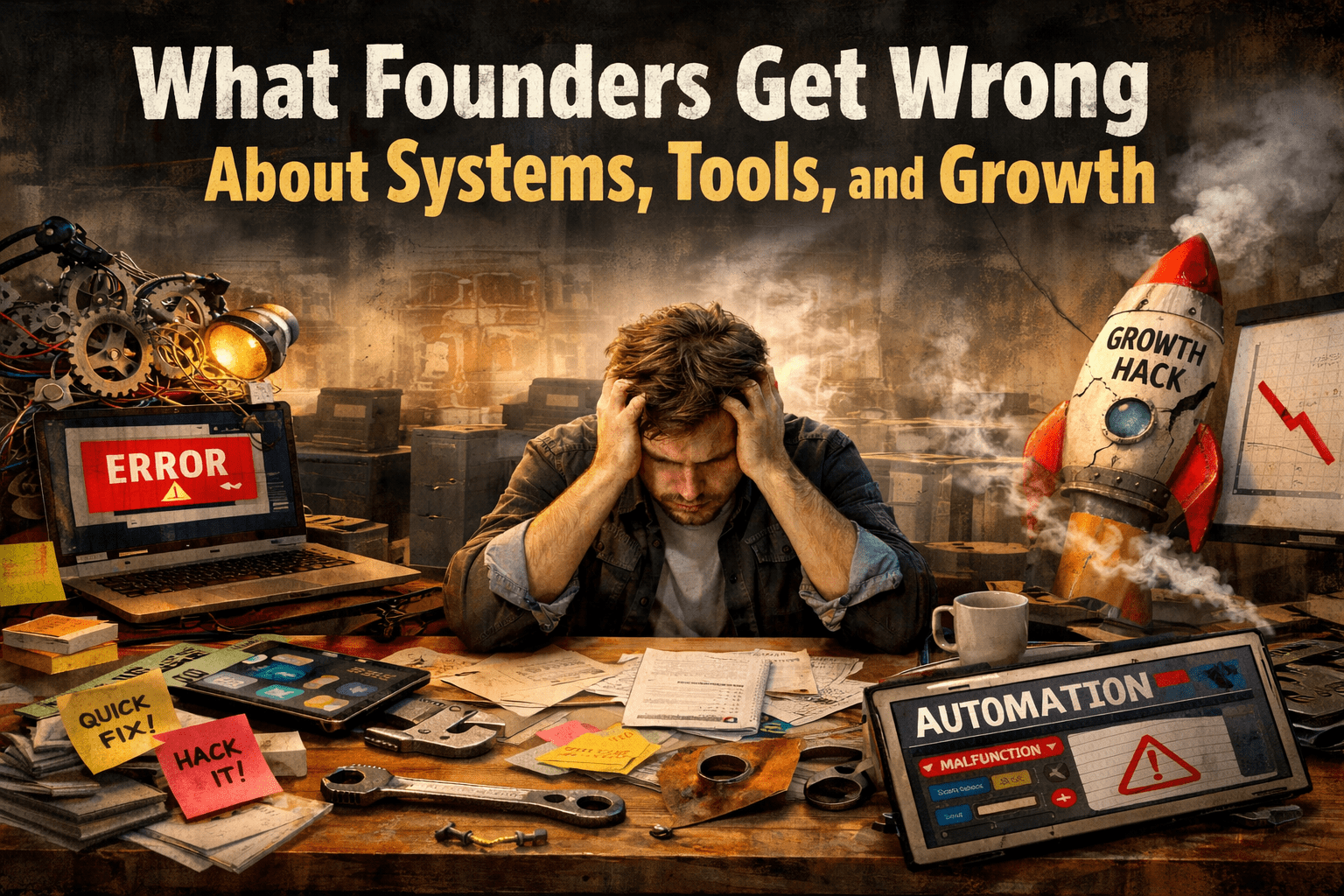
When founders set their sights on scaling a startup, their attention often gravitates toward the latest software, automation platforms, or rapid growth hacks. They imagine that adopting the newest tools or aggressively pursuing user acquisition will automatically propel their company to the next level. However, this focus on tools and growth metrics frequently overshadows a far more critical element: the underlying systems that enable a business to operate efficiently, consistently, and sustainably.
The reality is that what founders get wrong about systems, tools, and growth goes beyond mere oversight or poor planning. It is a strategic blind spot that can quietly undermine a company’s potential. Without well-designed systems, even the most sophisticated tools or aggressive growth initiatives can fail to deliver meaningful results. Growth becomes chaotic, processes break down, and the company struggles to maintain alignment as it expands.
In this article, we will dive deep into the common misconceptions that founders carry about systems, tools, and growth. Drawing on research, industry insights, and real-world experiences from successful and struggling startups alike, we’ll show why systems—not tools alone—are the real engine of scalable, sustainable growth. You’ll gain practical guidance on how to prioritize systems, integrate tools effectively, and build a growth strategy that’s resilient and repeatable, rather than fragile and dependent on ad hoc fixes.
By understanding the interplay between systems, tools, and growth, founders can move from reactive problem-solving to proactive strategy—unlocking long-term performance, operational clarity, and the kind of growth that lasts.
Why Founders Misunderstand Systems, Tools, and Growth

In the early stages of a startup, founders often operate in survival mode. They juggle multiple roles, make countless decisions on the fly, and rely heavily on their own instincts to keep the company afloat. In this environment, tools—whether a new CRM, analytics dashboard, or marketing automation software—appear as the most tangible way to solve problems quickly. After all, if a tool can automate a task, reduce manual work, or give better insights, it seems like an immediate win. metamorphyst
However, what many founders fail to realize is that tools are only as effective as the systems they support. Without clearly defined processes, responsibilities, and workflows, tools can become nothing more than expensive distractions. Data gets siloed, team members duplicate efforts, and important decisions fall through the cracks. In essence, tools alone cannot create the structured environment necessary for sustainable growth.
This misalignment is a common blind spot, and it is precisely what founders get wrong about systems, tools, and growth. They assume that implementing the latest software or adopting a trendy methodology will automatically translate into better outcomes. In reality, growth is not just a technological problem—it is a systems problem. Real, scalable growth depends on having repeatable processes, clearly defined roles, and measurable feedback loops that allow the organization to learn and adapt efficiently.
For example, consider a startup that invests heavily in marketing automation tools to generate leads. Without a system to track lead quality, assign ownership, and follow up consistently, many of those leads will be lost. The tools may produce more data, but they do not solve the underlying operational inefficiency. Growth metrics may improve temporarily, but the foundation for long-term success remains weak.
The key takeaway is that systems are the invisible architecture that supports growth. Tools amplify your systems, but they cannot replace them. Understanding this distinction early allows founders to focus on building operational strength before scaling aggressively—ensuring that growth is sustainable rather than fragile. tidyrepo
By appreciating why so many founders misunderstand the relationship between systems, tools, and growth, you begin to see why the most successful startups prioritize process design and organizational clarity over chasing every new tool or growth hack. This mindset shift is the first step toward building a company capable of scaling efficiently, delivering consistent results, and sustaining long-term success.
Systems vs. Tools: More Than Just Software
One of the biggest misconceptions among founders is confusing tools with systems. At first glance, they may seem similar: both can help streamline operations, automate tasks, and increase efficiency. But the difference is profound, and understanding it is crucial to avoiding the pitfalls that many startups face during scaling.
Tools are tangible solutions—software platforms, apps, or automation technologies designed to perform specific functions. Think of project management apps, CRMs, email marketing platforms, or analytics dashboards. They are the “what” that makes certain tasks easier or faster. On the other hand, systems are the underlying processes, workflows, and decision-making structures that govern how work actually gets done. Systems define the “how” and the “who” behind every action, creating a repeatable, consistent way for teams to operate. metamorphyst
Many founders make the mistake of buying tools first and designing systems later. They invest in the latest marketing automation software or collaboration platform, assuming that it will automatically produce better outcomes. Yet, without clearly defined processes, these tools often create more confusion than clarity. Data is scattered, responsibilities overlap, and teams struggle to know which actions matter most. In short, tools without systems are like engines without steering—they provide power but no direction.
Consider a startup that adopts a sophisticated CRM to track customer interactions. Without a system that defines who follows up, when, and how, the CRM might capture lots of data but fail to convert leads into actual sales. The tool alone does not fix inefficiencies or misaligned workflows. Conversely, a startup that first establishes a clear system for lead assignment, follow-up cadence, and pipeline management will find that even a basic CRM becomes far more effective. The system creates the structure; the tool amplifies it.
The distinction also extends to growth strategies. Many founders assume that adding more tools—analytics dashboards, marketing platforms, or automation scripts—will automatically accelerate growth. However, without robust systems that tie acquisition, onboarding, retention, and feedback loops together, growth initiatives are often fragmented and short-lived. Real, sustainable growth emerges not from tools alone, but from well-designed systems that ensure processes scale predictably, with accountability and measurable outcomes. tidyrepo
In short, the mantra for founders should be: build your systems first, then select the tools that support and amplify them. This approach ensures that technology investments deliver true leverage, rather than adding complexity or masking operational weaknesses. By understanding this fundamental difference, founders can correct a critical blind spot and create the foundation for scalable, long-term success.
The Fallacy of “More Tools = Faster Growth”

A pervasive misconception among startup founders is the belief that piling on more tools will automatically accelerate growth. In the early stages, this seems logical: if one tool streamlines marketing, another improves analytics, and a third automates sales outreach, surely the company will scale faster. Yet, in practice, this assumption is often not just wrong—it can actively hinder growth.
The problem arises when tool adoption is disconnected from strategy and systems. Adding multiple platforms without a coherent operational framework creates what many growth experts call “tool fatigue.” Teams spend more time learning software, entering redundant data, and troubleshooting integrations than actually serving customers or improving the product. Instead of amplifying efficiency, the proliferation of tools can fragment workflows and obscure accountability.
For example, a startup may adopt five separate marketing and analytics tools to track leads, website traffic, and customer engagement. Without a clear system linking these tools—defining ownership, processes for using data, and feedback loops—the company ends up with a wealth of information but little actionable insight. Teams may chase vanity metrics, duplicate efforts, or overlook critical opportunities, resulting in slower, less predictable growth. tidyrepo
Another common trap is assuming that tools alone can fix organizational inefficiencies. Founders often believe that if the right software is in place, processes will magically run themselves. Yet growth is rarely a purely technological problem; it is fundamentally a systems and process problem. Tools can amplify strong systems, but they cannot substitute for poor workflows, unclear responsibilities, or weak operational alignment.
Real-world examples abound. Startups that focus excessively on acquiring the latest automation platforms may see temporary improvements in lead generation or productivity metrics, but without underlying systems, these gains are often short-lived. Conversely, companies that prioritize defining repeatable processes first—how work flows, who is accountable, and how performance is measured—then select tools to support those processes achieve sustainable growth and operational clarity. metamorphyst
In essence, the key lesson is clear: tools should be amplifiers, not substitutes. Growth is not the result of more software licenses or fancy dashboards; it is the product of well-designed systems that can scale efficiently, reinforced by tools that enhance performance rather than create distraction. Founders who internalize this principle move from reactive, fragmented growth strategies to proactive, resilient scaling—laying the groundwork for long-term success.
Common Founder Mistakes Around Systems and Growth

Understanding what founders get wrong about systems, tools, and growth requires examining the most frequent mistakes that early-stage leaders make. These errors are not just minor operational missteps—they are structural weaknesses that can stunt growth, create inefficiencies, and ultimately threaten the long-term sustainability of a startup.
1. Relying on Ad Hoc Processes
In the rush to execute, many founders default to ad hoc workflows. Tasks are managed through informal channels—spreadsheets, chat apps, or verbal instructions—without standardized procedures. While this approach may work when a team is small, it becomes increasingly fragile as the company grows. Miscommunications, duplicated work, and missed deadlines quickly multiply.
For example, a startup that tracks customer support manually via email threads may initially manage a small volume of inquiries effectively. However, as the user base expands, issues are overlooked, response times increase, and customer satisfaction declines. The lack of formal systems creates inefficiencies that no tool can fully solve. metamorphyst
2. Treating Growth as a Channel Problem
Many founders focus excessively on channels—ads, social media campaigns, or email marketing—believing that growth is purely about acquisition. While channels are important, growth is actually a systemic outcome that depends on repeatable processes for acquisition, onboarding, retention, and feedback.
A common mistake is investing heavily in marketing automation tools without defining how leads will be qualified, assigned, and followed up. The result is a surge of activity that looks like growth on the surface but lacks the underlying infrastructure to convert prospects into long-term customers. Growth that is treated solely as a channel problem is often fragmented, short-lived, and unpredictable.
3. Underdeveloped Operational Infrastructure
Scaling stresses all parts of a startup: workflows, communication, quality control, and team alignment. Founders who neglect operational infrastructure before rapid expansion are setting their companies up for collapse. tidyrepo
For instance, a tech startup may hire new engineers quickly to meet product demand without implementing proper onboarding systems. Code review, documentation, and cross-team communication may falter, leading to slower development cycles and higher error rates. Strong systems, established early, provide the framework to integrate new team members, manage complexity, and maintain performance during periods of rapid growth.
4. Ignoring Human and Process Factors
Tools and systems are only effective when they account for human behavior. Founders often focus on technology while overlooking the social and organizational elements that influence success.
For example, automating workflows without clarifying roles, responsibilities, or accountability can create confusion and resistance. Employees may ignore the tool, bypass the process, or duplicate work. Well-designed systems incorporate both technology and human factors, ensuring that processes are intuitive, adopted consistently, and aligned with team behaviors.
Key Takeaway: These mistakes highlight a common theme: growth cannot be achieved simply by stacking tools or executing ad hoc processes. Instead, founders must design repeatable, accountable systems that integrate technology with human workflows. By addressing these structural weaknesses early, startups can move from reactive firefighting to proactive, scalable growth. tidyrepo
How Smart Founders Get It Right

While many startups stumble because of misplaced focus on tools over systems, some founders consistently achieve scalable, sustainable growth by understanding the right sequence: systems first, tools second, growth third. The difference lies in mindset, planning, and operational discipline.
1. Build Systems Before Tools
The most successful founders prioritize process design before technology acquisition. This means clearly defining workflows, responsibilities, and decision-making frameworks before adopting any tool to automate or optimize them.
For example, before selecting a customer relationship management (CRM) platform, a founder should define:
- Who is responsible for each stage of the sales pipeline
- How leads are qualified and assigned
- What follow-up cadence ensures consistency
- How success metrics are measured and reported
Once these systems are in place, tools become amplifiers of efficiency rather than expensive, disconnected distractions. A CRM or project management platform will then support a structured workflow, ensuring that data translates into action rather than noise. tidyrepo
2. Use Tools to Amplify Systems
Founders who understand the systems-first approach use tools strategically. Tools should support and scale well-defined processes, not create them. For instance, automation platforms, analytics dashboards, and collaboration apps are effective when integrated into clear workflows with accountability and measurable outcomes.
Consider marketing automation: without a system for lead nurturing, follow-ups, and conversion tracking, automation may generate activity but not results. Conversely, when paired with a repeatable lead management system, automation tools increase efficiency, reduce human error, and accelerate growth sustainably. metamorphyst
3. Measure System Health, Not Just Tool Activity
Growth is a system-level outcome. Smart founders track metrics that reflect the effectiveness of their processes, not just tool usage. Examples include:
- Cycle time for key workflows
- Customer retention and repeat usage
- Adoption of standardized processes across teams
- Consistency in delivery and quality
By monitoring these indicators, founders gain insight into whether their systems are functioning as intended and can make data-driven adjustments. This is far more impactful than tracking tool-specific analytics alone, which can be misleading or incomplete.
4. Embed Feedback Loops
Systems thrive on learning. Founders who get it right design feedback loops that allow continuous improvement. Every process—from product development to marketing and customer support—should include checkpoints to evaluate performance, identify bottlenecks, and iterate quickly. metamorphyst
For example, a SaaS startup may use weekly reviews of onboarding metrics to identify where new users drop off. The insights feed back into the system, prompting process changes and tool adjustments. Over time, these iterative improvements compound, creating predictable, scalable growth.
5. Align Human Factors with Systems
Finally, smart founders recognize that systems are only effective when people adopt them consistently. They communicate expectations clearly, train teams thoroughly, and ensure that every role is accountable for specific outcomes. By aligning human behavior with structured processes, they turn abstract systems into actionable, repeatable operations that drive sustainable growth.
Key Takeaway: The formula for scaling successfully is simple but powerful: design systems first, implement tools second, and measure growth third. Founders who internalize this approach avoid the common traps of tool obsession, fragmented processes, and chaotic growth—and instead build organizations capable of scaling predictably and sustainably. tidyrepo
Conclusion: Systems First, Tools Second, Growth Third
Scaling a startup is often portrayed as a race: the faster you adopt new tools, launch campaigns, or hire talent, the faster you’ll grow. Yet, as countless founders have discovered, chasing tools or short-term growth hacks without a solid operational foundation is a recipe for chaos. The central lesson is clear: what founders get wrong about systems, tools, and growth is underestimating the power of structured, repeatable processes.
Tools alone will never drive sustainable growth. They are accelerators, not architects. Without robust systems in place, even the most advanced software, dashboards, or automation platforms fail to deliver meaningful results. Misalignment, inefficiency, and missed opportunities are inevitable when processes are ad hoc, responsibilities are unclear, and feedback loops are weak.
Smart founders flip the script. They design systems before tools, ensuring that every workflow, responsibility, and decision point is mapped and repeatable. Tools are then selected to amplify these systems, increasing efficiency, visibility, and accountability. Growth emerges naturally from this alignment, not from superficial activity or isolated technology investments.
The founders who truly succeed are those who prioritize clarity, structure, and accountability over quick fixes. They understand that growth is a systemic outcome, not just a metric to chase. By embedding feedback loops, aligning human behavior with processes, and measuring system performance, these founders build organizations capable of scaling predictably, efficiently, and sustainably.
Ultimately, the distinction is simple but profound: systems create the foundation, tools amplify it, and growth is the result. Recognizing this principle—and acting on it—separates startups that thrive from those that plateau or collapse. Founders who internalize this lesson position themselves not only to grow faster but to grow smarter, with resilience, repeatability, and long-term success at the core of their strategy.
👉Learn more : Supporting Early-Stage Founders with Scalable Digital Infrastructure and Practical Execution Support