Table of Contents
customer base, rising revenue, expanding teams, and entry into new markets. These achievements are celebrated as proof of success—but growth can also become one of the biggest threats to long-term stability, especially without a Central Operating System (COS) in place.
Businesses rarely fail because demand disappears. They fail because internal operations can’t keep up. Processes that once worked smoothly start to break down, communication becomes fragmented, and teams lose clarity on priorities. A COS is more than just software—it’s the backbone that aligns strategy with execution, connects departments, centralizes data, and ensures technology operates as an integrated ecosystem.
Without this foundation, growth introduces chaos. Teams work in silos, data lives in disconnected systems, and leaders make decisions reactively with incomplete information. Small inefficiencies multiply into bigger risks: misalignment increases, customer experiences become inconsistent, and operational costs rise faster than revenue.
Sustainable growth requires structure, visibility, and alignment. A Central Operating System transforms growth from a potential burden into a competitive advantage, enabling businesses to scale efficiently while avoiding the pitfalls that undermine even the most promising organizations.
1. Operational Chaos Replaces Efficiency
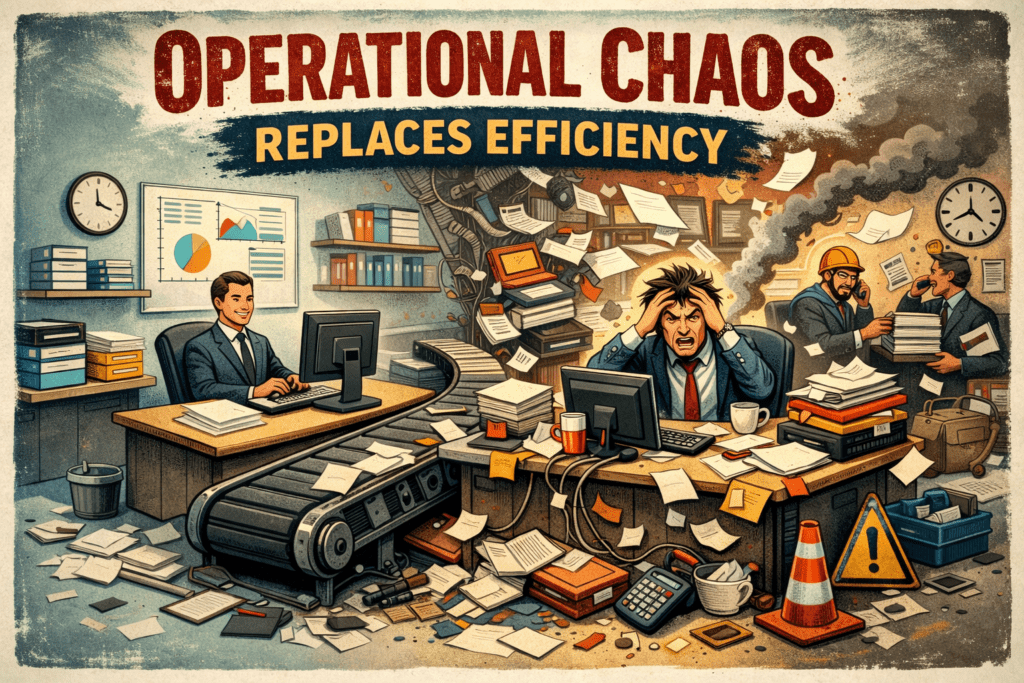
In the early stages of a business, it’s common for teams to rely on a patchwork of tools and methods to get work done. Spreadsheets track finances, emails coordinate tasks, messaging apps handle quick questions, and individual departments may use entirely separate software for their own needs. For a small team, this informal approach often seems sufficient. Communication flows easily, and employees can adapt quickly, compensating for inefficiencies with flexibility and personal attention.
However, as the business grows, this scattered approach quickly becomes a liability. What once felt manageable starts to generate friction. Teams begin to work in silos, with little visibility into what others are doing. Tasks are duplicated across departments because no one has a clear view of responsibilities. Crucial information gets lost in long email threads or buried in outdated spreadsheets, and even simple processes take far longer than they should. . onwavegroup
Without a central operating system (COS) to provide structure, standardize workflows, and centralize data, the very systems designed to help the business operate efficiently instead become bottlenecks. Daily operations slow down, errors increase, and employees spend more time navigating confusion than executing meaningful work. Instead of growth accelerating the company’s momentum, inefficiencies compound, turning expansion into a source of stress, frustration, and lost opportunity.
A COS eliminates these inefficiencies by providing a single framework where teams can collaborate seamlessly, processes are standardized across departments, and real-time data is accessible to everyone who needs it. It transforms a fragmented organization into a coordinated engine capable of handling the complexity that comes with scaling—ensuring that growth actually leads to productivity rather than chaos.
2. Poor Decision-Making Due to Fragmented Data

Growth is the ambition that drives every forward-thinking business. At first, it appears in exciting and tangible ways: a growing customer base, rising revenue, expanding teams, and entry into new markets. These milestones are often celebrated as proof that a company is on the right path. However, what many organizations discover too late is that growth itself can become one of the most dangerous threats to long-term success when operational complexity is not properly managed. CollabCRM
Businesses rarely fail because demand suddenly disappears. Instead, they struggle because internal operations can no longer keep up with the pace of expansion. Processes that once worked smoothly begin to break down. Communication becomes fragmented, decision-making slows, and teams lose clarity around priorities. As complexity increases, efficiency declines—and growth starts to feel more like a burden than an achievement.
At the center of this challenge is a critical and often overlooked factor: the absence of a central operating system. This framework is far more than a single piece of software or a collection of digital tools. It aligns strategy with execution, connects people across departments, standardizes processes, centralizes data, and ensures technology works as an integrated ecosystem rather than in isolation.
Without this unified foundation, growth introduces chaos instead of momentum. Teams operate in silos, information lives in disconnected systems, and leaders struggle to gain a clear, real-time view of the business. Decisions are made reactively, often based on incomplete or outdated data, leaving organizations to spend more time fixing internal problems than serving customers or innovating.
As companies scale without proper operational systems, small inefficiencies multiply into major risks. Misalignment between departments increases, customer experiences become inconsistent, and operational costs rise faster than revenue. Eventually, the very growth the business worked so hard to achieve begins to undermine its stability. waferwire
This is why businesses that attempt to scale without a central operating system place themselves at serious risk. Sustainable growth requires structure, visibility, and alignment. Without it, growth stops being a competitive advantage—and becomes the reason many promising businesses fail.
3. Teams Lose Alignment as the Company Scales

Alignment is the invisible glue that holds a growing organization together. In small teams, alignment comes naturally—everyone knows what others are working on, priorities are clear, and communication happens informally. But as a business expands, alignment becomes far more difficult to maintain. Departments multiply, teams operate in different locations or time zones, and individual roles grow more specialized. Without a centralized system to coordinate efforts, teams can quickly drift apart.
When alignment is lost, even small misunderstandings can snowball into major inefficiencies. Employees may duplicate work or pursue conflicting priorities, managers struggle to track progress, and key initiatives stall. The more disconnected teams become, the harder it is to ensure that every employee is working toward the same strategic goals. This misalignment doesn’t just slow productivity—it can erode morale, as employees feel frustrated by unclear expectations and constant rework.
A central operating system (COS) acts as the backbone of alignment. By providing a single framework for processes, goals, and communication, it ensures that every department and every team member understands how their work contributes to broader objectives. COS tools allow for transparent tracking of responsibilities, real-time updates, and centralized documentation, reducing the risk of confusion and enabling teams to move in sync.
In short, a COS transforms growth from a chaotic expansion into a coordinated, unified effort. Without it, scaling teams are likely to operate like isolated islands, each pulling in different directions, which undermines both efficiency and long-term success.
4. Customer Experience Becomes Inconsistent

As businesses grow, delivering a consistent and high-quality customer experience becomes increasingly challenging. In small teams, it’s easier to maintain personal connections with customers—questions are answered promptly, service feels tailored, and feedback loops are immediate. But as customer volume rises and operations expand, maintaining this level of attention becomes difficult without a central operating system in place to unify processes.
When departments operate with disconnected tools and fragmented processes, customers often feel the gaps. A support ticket might get lost between teams, a sales follow-up can be delayed, or marketing messages may not reflect previous interactions. These inconsistencies frustrate customers and can erode trust in the brand. In a competitive market, even small lapses in experience can lead to lost opportunities and diminished loyalty.
A central operating system ensures that every team has access to complete, real-time customer information. Sales, support, and marketing can see the same customer history, track interactions, and collaborate seamlessly. This allows businesses to deliver a consistent, personalized experience at every touchpoint, even as customer numbers grow.
By unifying customer data and processes, a central operating system transforms growth from a source of potential chaos into a platform for superior service. Without it, businesses risk alienating the very audience they worked so hard to attract, turning expansion into a liability rather than an advantage.
5. Growth Exposes Process Weaknesses

Many businesses experience early growth despite having inefficient processes—not because they are well-optimized, but because small-scale operations allow employees to compensate for gaps manually. What works for a team of five or ten quickly becomes unmanageable for a team of fifty or more. As transaction volume increases, those minor inefficiencies escalate into serious bottlenecks, slowing operations and frustrating both employees and customers. waferwire
Processes that were informal or inconsistently followed in the early stages suddenly become high-stakes vulnerabilities. Manual approvals take longer, communication breaks down, and critical tasks can be delayed or overlooked. Without a central operating system to document, standardize, and automate workflows, these weaknesses are amplified rather than mitigated, leaving the business vulnerable to errors, missed deadlines, and lost revenue.
A central operating system acts as a safeguard against process breakdowns. It provides a clear framework for how work should be done, automates repetitive tasks, and ensures that every team follows standardized procedures. By doing so, it allows the organization to scale efficiently, maintain consistency, and reduce the strain that growth places on internal operations.
In essence, growth exposes inefficiencies—but a central operating system turns potential weaknesses into opportunities for optimization, creating a resilient foundation that can handle increased complexity without collapsing.
6. Leadership Becomes Reactive Instead of Strategic

As businesses scale, leaders often find themselves trapped in a cycle of constant problem-solving rather than steering the company toward long-term success. In small teams, decision-making is relatively straightforward, and issues can be resolved quickly. However, as a business grows, operations become increasingly complex, and leaders are pulled in multiple directions—addressing miscommunication, correcting errors, chasing updates from disconnected teams, and resolving workflow bottlenecks. Without a Central Operating System, this complexity can overwhelm even the most capable executives, leaving little time for strategic planning or innovation.
The absence of a Central Operating System creates a lack of visibility across the organization. Leaders struggle to see real-time performance metrics, track workflow inefficiencies, or anticipate operational risks. Decisions are often made reactively, based on anecdotal feedback or incomplete information, rather than data-driven insights. As a result, critical strategic initiatives can be delayed or deprioritized, innovation slows, and opportunities for growth are frequently missed. Operational complexity without a structured framework can turn growth into a burden, rather than a competitive advantage.
Implementing a Central Operating System transforms this dynamic. By centralizing data, standardizing workflows, and integrating systems, a COS provides leaders with a clear, real-time overview of operations. Dashboards and performance metrics allow executives to monitor key trends, identify bottlenecks before they escalate, and make proactive, informed decisions. Leaders are no longer consumed by daily fires; instead, they are empowered to focus on high-value priorities, strategic initiatives, and long-term vision execution.
Moreover, a Central Operating System fosters alignment across teams and departments. When processes are standardized and data is centralized, collaboration improves, communication becomes more effective, and errors caused by misalignment are minimized. Teams operate more efficiently, freeing leadership from micromanagement and reactive decision-making. This creates an environment where strategic goals are not just aspirational—they are actionable and achievable.
In today’s fast-paced business environment, scaling without a Central Operating System is a risk few organizations can afford. The COS acts as the backbone of operational efficiency, enabling leaders to transition from reactive management to strategic guidance. By providing visibility, structure, and integration, a Central Operating System ensures that businesses can grow sustainably, seize opportunities, and maintain a competitive edge without being derailed by operational chaos.
Ultimately, a Central Operating System is not merely a tool—it is a critical enabler of leadership effectiveness, operational alignment, and sustainable growth. Leaders who embrace this framework can focus on guiding their organizations toward their vision, rather than being trapped in the day-to-day crises that often accompany scaling.
7.Central Operating System: Controlling Costs During Growth
A central operating system (COS) is critical when businesses grow, because inefficiencies that were manageable at a small scale can quickly become expensive liabilities. Many organizations respond by hiring more employees to compensate for gaps in processes, communication, and data management. While adding headcount may temporarily address operational issues, it also dramatically increases costs—and does not solve the underlying problems.
As teams expand without a central operating system and standardized workflows, duplicated effort, miscommunication, and errors continue to occur, meaning more resources are spent just to maintain the same level of output. Operational costs rise faster than revenue, margins shrink, and the business can enter a dangerous cycle of overstaffing and inefficiency. Growth, instead of fueling profitability, starts to strain finances and limit strategic investments.
A central operating system mitigates these challenges by enabling smarter scaling. By centralizing workflows, automating repetitive tasks, and providing visibility into resource allocation, a COS allows organizations to do more with fewer resources. Teams become more productive, processes become more efficient, and growth can be supported without unnecessary spending.
Ultimately, a central operating system turns cost management into a strategic advantage. Without it, scaling becomes a financial risk, as operational inefficiencies multiply and undermine the very growth the business is trying to achieve.
8. Technology Becomes a Burden, Not an Advantage
Many growing businesses invest heavily in technology, assuming that adding more tools will automatically improve efficiency and performance. In reality, without a central operating system (COS), technology often becomes a source of complexity rather than a solution. Multiple disconnected platforms can lead to redundant work, fractured data, and frustration among employees who must navigate a maze of systems just to complete routine tasks.
When tools aren’t integrated, employees spend valuable time switching between applications, manually transferring data, and reconciling inconsistencies. Teams can end up working harder rather than smarter, and the intended benefits of technology—speed, accuracy, and collaboration—are lost. In some cases, the investment in software multiplies operational challenges, creating inefficiencies that grow alongside the business. winpro
A COS ensures that technology serves as a true enabler of growth. By unifying systems, centralizing data, and standardizing workflows, a COS allows technology to work cohesively rather than in silos. Teams can automate repetitive tasks, access real-time insights, and collaborate seamlessly across departments. Instead of being bogged down by disparate tools, employees can focus on strategic initiatives, innovation, and delivering value to customers.
In essence, a central operating system transforms technology from a burden into a competitive advantage. Without it, even the most advanced tools can contribute to operational chaos and undermine the very growth they were intended to support.
Conclusion: Growth Needs Structure to Thrive
Scaling a business is often celebrated as the ultimate measure of success, but growth without a solid foundation is a hidden danger. Many businesses fail not because their products or services are in demand, but because their operations can’t keep pace with expansion. Disconnected systems, misaligned teams, fragmented data, and inefficient processes transform what should be an exciting period of opportunity into a period of chaos, frustration, and lost potential.
A central operating system (COS) is the framework that allows growth to be sustainable. It aligns strategy with execution, integrates technology, centralizes data, and standardizes workflows, ensuring that every team operates efficiently and in sync. With a COS, leaders gain visibility and control, employees gain clarity and direction, and customers enjoy consistent, high-quality experiences—even as the business scales.
Investing in a central operating system is not optional for businesses that aim to grow sustainably. It is the backbone that turns operational complexity into coordinated efficiency, enabling organizations to scale with confidence, maintain profitability, and achieve their long-term vision. Without it, growth becomes a risk rather than an advantage, and even the most promising businesses can falter under the weight of their own expansion.
In short, growth needs structure to thrive—and a central operating system provides exactly that. It transforms scaling from a potential liability into a strategic advantage, laying the foundation for lasting success.
Read more : Streamlining Business Communication Through Unified Digital Solutions