Table of Contents
Growth is often praised as the clearest proof that a business is moving in the right direction. An expanding customer base, rising revenue, and larger teams are widely seen as milestones worth celebrating. On the surface, these indicators suggest stability, momentum, and long-term success. However, beneath this positive narrative, company scaling challenges often begin to emerge quietly and gradually, long before they become visible problems.
What once functioned effortlessly in a small, agile organization—informal communication, flexible roles, and quick decision-making—can start to break down as complexity increases. More people mean more dependencies, more customers create higher expectations, and rapid growth puts pressure on systems that were never designed to operate at scale. Without intentional changes, small inefficiencies multiply, turning everyday operations into sources of friction.
Understanding what actually breaks inside a company as it scales is not about resisting growth; it is about managing it intelligently. By recognizing early signs of company scaling challenges, leaders can proactively strengthen processes, align teams, and adapt their operating model. This awareness becomes the first critical step toward preventing long-term damage and transforming growth from a source of stress into a sustainable competitive advantage.
1. Communication Is the First Thing to Break

One of the earliest and most damaging company scaling challenges is the breakdown of communication. In the early stages of a business, communication is simple, fast, and largely informal. Team members sit close to each other, decisions are made in real time, and everyone has a clear understanding of priorities simply by being involved in day-to-day discussions. Information flows naturally, and alignment happens almost automatically. Lua CRM
As the company grows, this dynamic changes dramatically. Teams expand, new departments are created, and remote or hybrid work becomes more common. The informal communication methods that once worked—quick chats, verbal updates, or ad-hoc meetings—are no longer sufficient. Important information gets trapped in email threads, messaging apps, or individual inboxes, creating gaps in understanding across the organization.
This communication breakdown leads to several cascading company scaling challenges. Teams begin working with incomplete or outdated information, which results in duplicated efforts, conflicting priorities, and avoidable mistakes. Employees may feel disconnected from leadership decisions, while leaders struggle to maintain visibility into what is actually happening on the ground. Over time, misalignment becomes the norm rather than the exception.
Without clear communication structures—such as documented processes, centralized knowledge systems, and defined reporting channels—growth amplifies confusion instead of clarity. What should be a sign of progress turns into operational noise. Addressing communication early is critical, because once scaling accelerates, fixing miscommunication becomes far more complex and costly.
2. Processes That Once Worked Turn Into Bottlenecks
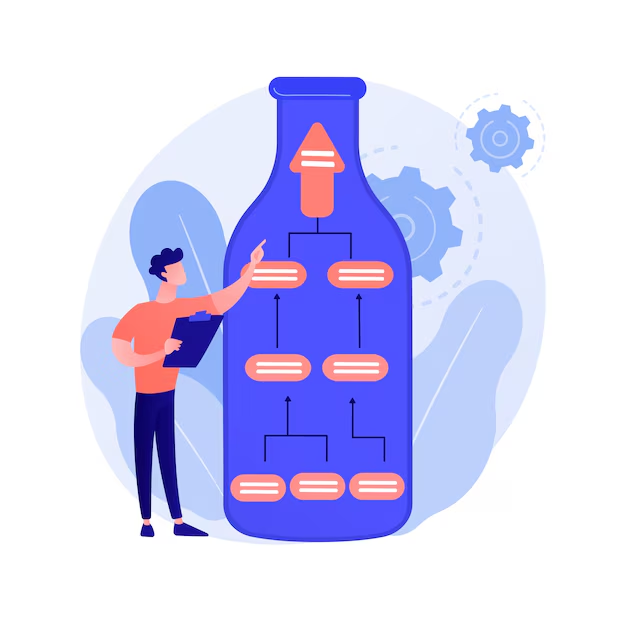
As a company grows, one of the most visible company scaling challenges is the way existing processes begin to slow everything down. In the early stages, speed and flexibility matter more than structure. Teams rely on simple workflows, manual approvals, and unwritten rules to get things done quickly. This approach feels efficient when the organization is small and everyone understands how things work.
However, as the company scales, these same processes become a source of friction. What was once a quick decision now requires multiple approvals. Tasks that were handled informally start to depend on specific individuals, creating delays when those people are unavailable. Because processes are rarely documented, new employees struggle to understand how work should be done, leading to inconsistent execution across teams.
These inefficiencies quickly evolve into serious company scaling challenges. Work piles up, productivity drops, and teams spend more time navigating internal obstacles than delivering value. Instead of enabling growth, outdated processes restrict it. Employees often compensate by creating their own workarounds—spreadsheets, personal tools, or unofficial methods—which further fragments operations.
Without intentional process design, scaling magnifies every weakness in the system. Standardizing workflows, automating repetitive tasks, and clearly defining ownership become essential steps. When processes evolve alongside growth, they support speed and consistency. When they don’t, they turn growth into a bottleneck that slows the entire organization.
3. Leadership Breaks When Roles Don’t Evolve With Growth
Leadership is often one of the most underestimated and critical company scaling challenges that organizations face as they expand. In the early stages of a business, founders and senior leaders are deeply embedded in day-to-day operations. They make decisions swiftly, resolve problems directly, and maintain close, personal relationships with every team member. This hands-on approach works effectively in a small organization, where agility, speed, and control are essential for survival and early growth.
However, as the company grows, this style of leadership becomes increasingly unsustainable. Teams expand, new departments and specialized roles emerge, and multiple layers of management are introduced. Leaders can no longer be involved in every decision, and the systems that once allowed for quick execution start to strain under the weight of added complexity. When leadership roles do not evolve in tandem with organizational growth, leaders inadvertently become bottlenecks rather than enablers. Decisions slow down, approvals pile up, and overall progress becomes dependent on a few key individuals, creating frustration and inefficiency.
This situation generates a profound company scaling challenge: leaders become overwhelmed while employees feel disempowered. Micromanagement often increases—not out of a desire to control, but because leaders lack the infrastructure, processes, and middle management necessary to delegate effectively. Strategic thinking also suffers, as leaders spend the majority of their time reacting to operational fires rather than focusing on long-term objectives, innovation, and growth strategy. The inability to scale leadership effectively can stifle the organization’s potential, erode morale, and create tension between teams and management.
Successfully scaling leadership requires a fundamental shift in approach. Leaders must transition from “doing the work” themselves to “building systems” that empower others to execute independently. This includes developing capable middle management, clearly defining roles and responsibilities, establishing decision-making authority, and fostering a culture of trust and accountability. When leadership evolves alongside the organization, it becomes a stabilizing force that drives clarity, alignment, and strategic focus.
Failing to adapt leadership structures, however, can have cascading consequences. Bottlenecks, slow decision-making, and disengaged employees compound over time, slowing growth and creating unnecessary friction. By recognizing and addressing this company scaling challenge, organizations can ensure that leadership not only supports but accelerates growth, turning potential vulnerabilities into strengths that sustain long-term success.
4. Company Culture Slowly Erodes as Growth Accelerates
Company culture is often strongest when a business is small. Shared values, informal norms, and a clear sense of purpose naturally guide behavior. Everyone understands how decisions are made, how people collaborate, and what the company stands for. However, as growth accelerates, culture becomes one of the most fragile company scaling challenges.
When new employees are hired rapidly, cultural alignment can no longer rely on observation alone. Without clearly defined values and expectations, people bring their own interpretations of how work should be done. Over time, teams begin to operate differently, creating inconsistencies in behavior, collaboration, and performance. What once felt unified slowly starts to fragment.
This cultural erosion often goes unnoticed at first. Productivity may remain high, but engagement declines. Misunderstandings increase, internal conflicts become more frequent, and employees feel less connected to leadership and the company’s mission. These are classic company scaling challenges that weaken trust and reduce long-term retention.
Preserving culture during growth requires intention. Values must be documented, reinforced by leadership, and embedded into hiring, onboarding, and performance management. When culture scales with the company, it becomes a powerful force that aligns teams and drives performance. When it doesn’t, culture fades quietly—leaving confusion and disengagement in its place. Cedar Operations
5. Decision-Making Slows and Becomes Riskier

As a company grows, one of the most significant and often underestimated company scaling challenges is the slowdown and increased risk in decision-making. In smaller organizations, decision-making is typically fast, flexible, and highly effective. Founders and early leaders have a clear line of sight into every project, client interaction, and operational detail. Decisions are often guided by direct observation, intuition, and immediate feedback, allowing the organization to respond quickly to opportunities and challenges alike.
However, as the organization expands, this clarity begins to diminish. Teams multiply, departments specialize, and management layers increase. The larger the organization, the harder it becomes for a single leader to maintain visibility over all activities. Decisions that were once straightforward now require input from multiple stakeholders, formal reviews, and approvals. Without proper processes, this can lead to significant delays, missed opportunities, and mounting frustration across teams. First Round
Data management becomes another critical factor. While small companies often operate with accessible, centralized information, growth frequently leads to data fragmentation. Information may reside in separate systems, outdated reports, or isolated spreadsheets. Teams may rely on inconsistent metrics or incomplete datasets to inform their work. Leaders forced to make decisions with fragmented or inaccurate information risk making errors, which can slow progress or even harm the company’s trajectory. This illustrates a key company scaling challenge: decision-making becomes slower, more complex, and inherently riskier as operations expand.
To address this, companies must implement structured decision-making processes and real-time visibility into operations. Centralized data systems, clear escalation paths, and well-defined roles empower employees to act confidently and efficiently. Automation tools, dashboards, and reporting systems provide leaders with accurate, up-to-date insights to guide strategic choices. When properly executed, decision-making scales with the organization, enabling growth while minimizing risk.
Neglecting this area, however, can have cascading effects. Slow or flawed decisions affect every part of the business—from operational efficiency to customer experience—and can create bottlenecks that erode competitive advantage. By prioritizing structured, data-driven, and transparent decision-making, companies can transform this company scaling challenge into a driver of sustainable growth and long-term success.
6. Customer Experience Faces Growing Challenges
As a company expands, one of the most visible and potentially damaging company scaling challenges is the gradual erosion of customer experience. In smaller organizations, service tends to be highly personalized, responsive, and consistent. Customers often develop a strong connection with the team, and even minor issues are addressed swiftly because employees intimately understand the company’s products, services, and client expectations. This personal touch fosters loyalty and builds trust, creating a solid foundation for growth.
However, as the company grows in size and customer volume, maintaining this level of consistency becomes increasingly difficult. Teams become specialized, roles are divided, and responsibilities are often distributed across multiple departments. While specialization improves efficiency internally, it can create communication gaps between teams, leading to fragmented customer interactions. Without standardized procedures, documented service protocols, and integrated systems, customers may receive conflicting information, delayed responses, or inconsistent levels of service depending on who they interact with.
The consequences of these inconsistencies are significant. Loyal customers may feel overlooked, frustration can rise, and confidence in the brand may erode. Negative experiences spread rapidly through social media, online reviews, and word-of-mouth, potentially undoing years of work invested in building a strong reputation. These challenges are a classic example of company scaling challenges: the very structures and processes that supported early growth may inadvertently undermine customer satisfaction if not carefully managed.
To prevent the customer experience from deteriorating, scaling companies must proactively invest in the right systems, processes, and training. Establishing clear service protocols ensures consistency across all touchpoints, while centralized customer data and automated workflows allow teams to respond efficiently and accurately. Feedback systems provide valuable insights to continuously improve interactions and address issues before they escalate. By aligning people, processes, and technology, companies can maintain a high-quality customer experience that scales alongside growth. Medium
In essence, proactively managing customer experience during expansion transforms a potential vulnerability into a strategic advantage. Companies that address these company scaling challenges can scale confidently, ensuring their reputation, customer loyalty, and overall brand strength grow in parallel with their operations.
7. Technology Becomes a Limitation Instead of an Enabler

One of the most underestimated company scaling challenges lies in the role of technology. In the early stages of a business, teams often manage operations with simple tools—spreadsheets, basic project management applications, and standalone software solutions. These tools are sufficient when the organization is small, workflows are straightforward, and data volumes are manageable. Technology at this stage is largely seen as an enabler, helping the company operate efficiently without requiring major investment or complex infrastructure.
However, as the company grows, these same tools that once supported efficiency can quickly turn into obstacles. Systems that do not communicate with one another create data silos, preventing information from flowing smoothly between departments. Critical insights can get trapped in isolated applications, making coordination difficult and increasing the risk of errors. Spreadsheets multiply, manual workarounds become common, and reporting processes grow cumbersome and time-consuming. What once facilitated productivity now slows it down, creating bottlenecks across the organization.
This technological limitation also amplifies other company scaling challenges. Misaligned systems lead to duplicated work, inconsistent reporting, and delays in decision-making. Employees spend an increasing amount of time reconciling data instead of focusing on strategic initiatives that drive growth. Meanwhile, leaders struggle to gain clear visibility into operations, which complicates planning and prevents proactive problem-solving. The company’s growth potential is compromised not because of a lack of vision, but because technology has failed to keep pace with organizational needs.
Addressing this issue requires intentional and strategic investment in scalable technology solutions. Integrated platforms that connect teams and data, automation tools that reduce manual work, and centralized systems that consolidate information are critical. These solutions enable employees to operate efficiently even as complexity grows, support better decision-making, and provide leaders with the insights they need to manage growth effectively. When technology evolves alongside the company, it becomes a powerful enabler that drives accuracy, speed, and collaboration. When it fails to evolve, it becomes a major bottleneck, limiting growth and creating frustration across the organization.
Conclusion: Scaling Breaks Systems, Not Ambition
Growth is rarely the problem for a company—it is the very goal that drives teams to push boundaries, innovate, and reach new markets. Yet as businesses expand, they inevitably encounter company scaling challenges that test the resilience of their systems, processes, and leadership. What worked perfectly in a small, agile organization often begins to break under the weight of increased complexity.
The most common fractures are not in the company’s ambition or vision, but in the underlying structures that support day-to-day operations. Communication becomes fragmented, processes turn into bottlenecks, leadership struggles to delegate effectively, and culture begins to erode. Decision-making slows and becomes riskier, customer experience loses consistency, and outdated technology can transform from a helpful tool into a limiting factor. Each of these issues may seem minor individually, but together they can create significant operational strain if left unaddressed.
The key to overcoming these challenges lies in recognition and proactive adaptation. Companies that scale successfully are those that treat growth as more than just numbers—they treat it as a test of their internal systems. Investing in structured communication, robust processes, leadership development, cultural alignment, consistent customer experience, and scalable technology enables businesses to expand without losing their operational effectiveness.
Ultimately, scaling does not break ambition—it exposes gaps in readiness. By understanding and addressing these company scaling challenges, organizations can turn potential points of failure into opportunities for improvement, creating a foundation that supports sustainable growth. Growth then becomes a manageable, strategic, and rewarding journey, rather than a chaotic experience that strains the company from within.
Read more : When a Business Outgrows Spreadsheets and Manual Processes